Our History
Est. 1771
The Church on the Green
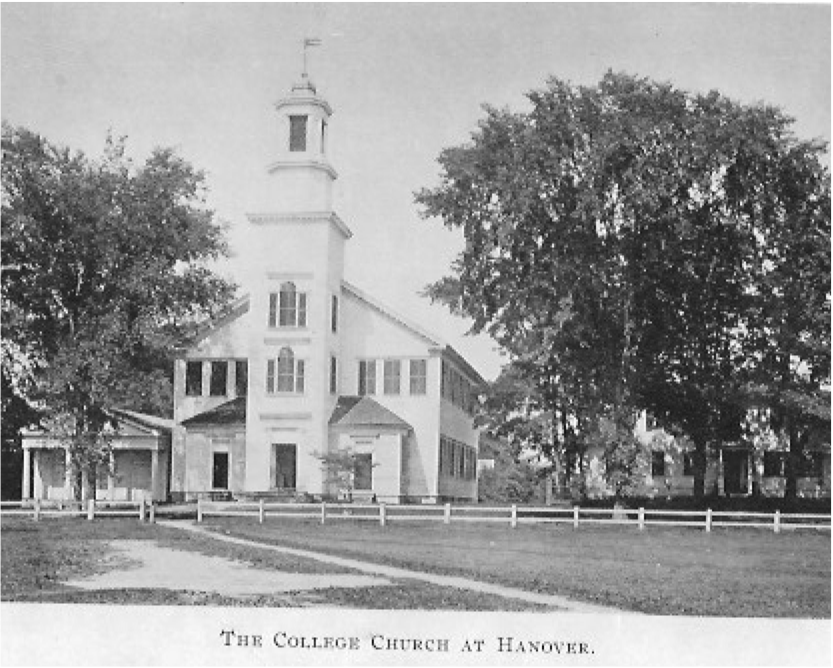
In 1794, as George Washington was serving his second term as U.S. President, The Church of Christ at Dartmouth College established a new home in a prominent structure centrally located on the Dartmouth Green (in front of today’s Sanborn Library). With its new coat of white paint, one can imagine the new building shining among the still-wild environs of Hanover.
It’s hard to overstate the importance of the building, and the church, to Dartmouth students.
In May 1946, the Dartmouth Alumni Magazine published a retrospective 6-page article (with 6 photos), “The White Church: Historic Church at Dartmouth Marks 175th Anniversary.” Authors Frances Lane Childs and Ernest Bradlee Watson wrote the church “has served for 175 years as the chief religious light of Hanover.
Part of it was the physical space it offered. Indeed, for 112 years the “White Church” served as the setting for important public exercises of the college. According to a May 1986 Dartmouth Alumni Magazine article titled, “The Lord’s Barn,” some 6,000 seniors held their commencements there, and speakers who stood behind the pulpit included Oliver Wendell Holmes, Ralph Waldo Emerson, and Walt Whitman.
Just after the end of World War I, the Church and the College moved towards formal and amicable separation. Leading up to this action, all compulsory student attendance had been abolished in 1903 during a major growth in College enrollment. The number of students graduating almost quadrupled from 1890 to 1910, so it would have been difficult to fit all the students into the balcony of the Church in any event. In 1908, graduation ceremonies were moved to the new Webster Hall (now Rauner Library).
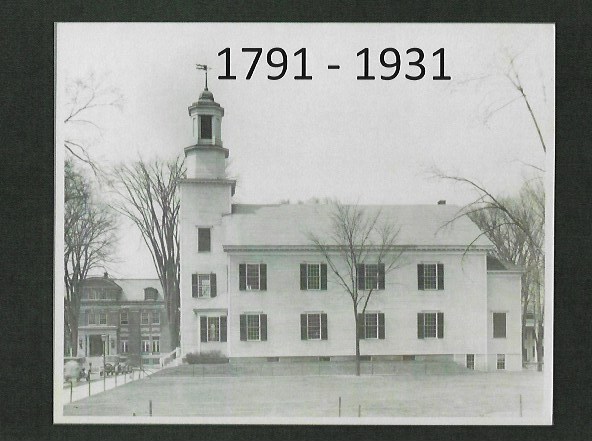
The Fire of 1931
With the construction of Baker Library and Sanborn Hall in the 1920’s the old Congregational Church building was being squeezed for room, and talks had started between the Church and the College to find another site. But on the evening of May 13, 1931, the old Church burned to the ground in a spectacular fire seen from miles around. The pulpit bible and a few other items were saved from the blaze due to quick actions by some students, but the building was completely destroyed, no firm cause for the fire was found. The College graciously allowed the use of Rollins for Sunday services while the Church considered its options to rebuild.
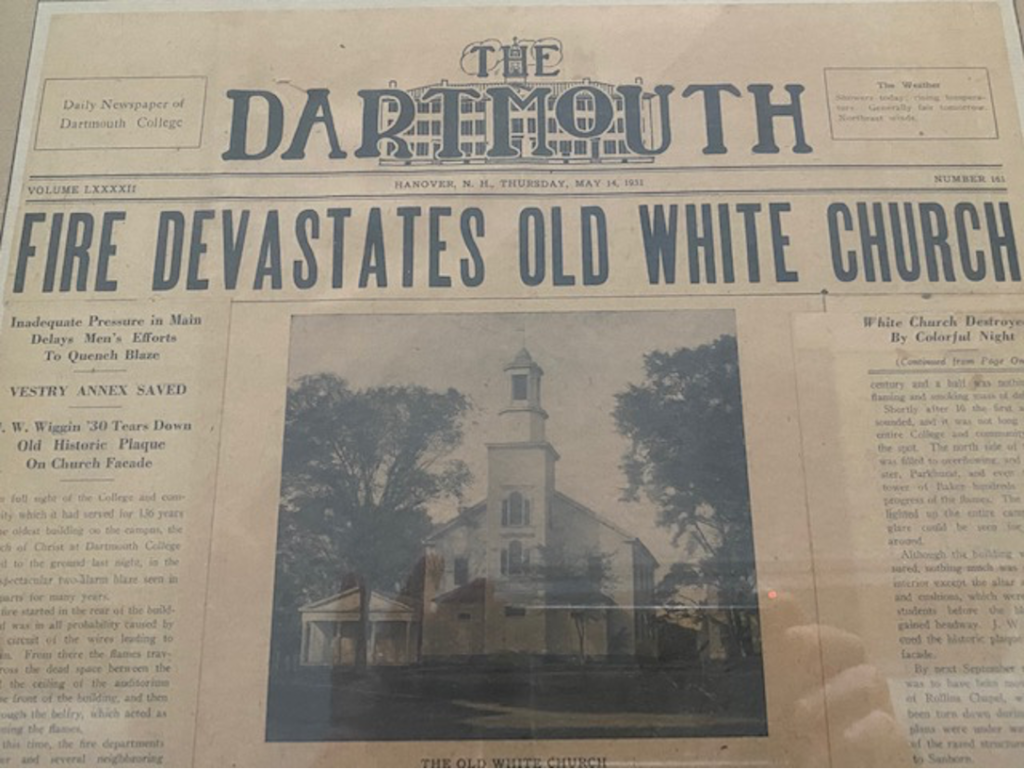
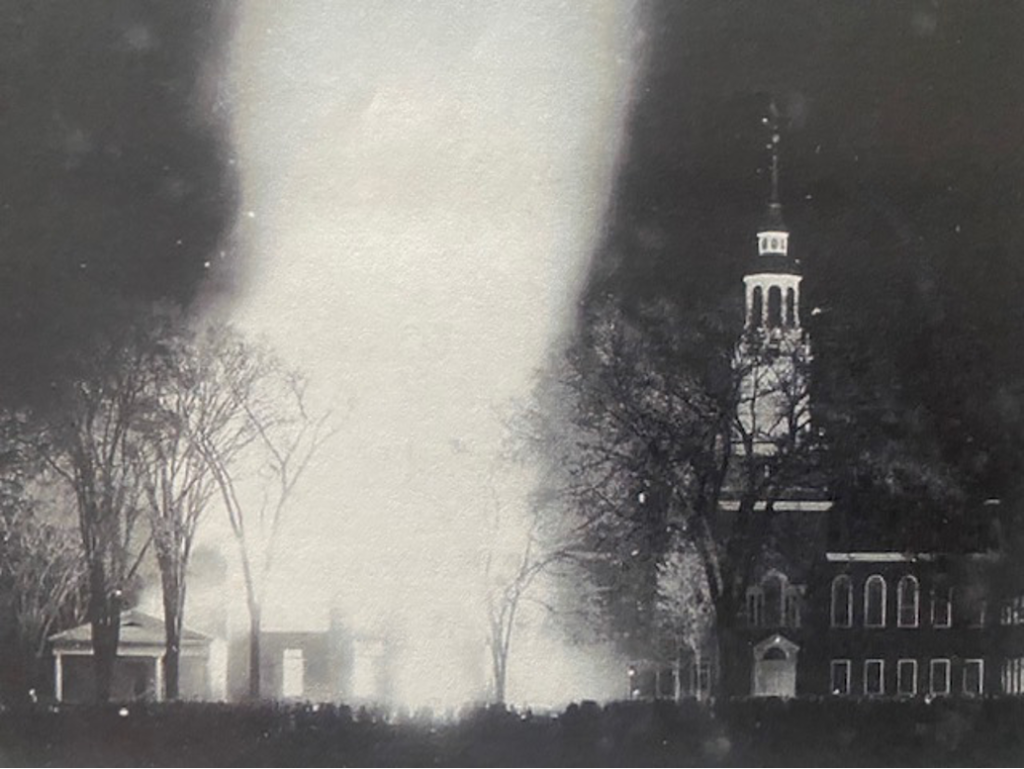
The building’s ending on the night of May 13, 1931 was as awesome as its 112 years of service: it burned to the ground in an hour in a massive conflagration, and the fire was a “where were you when?” moment for all in Hanover. “All these many years later my mind’s eye still holds the image of the flames from the historic church fire, dancing and leaping on my bedroom wall,”commented a townsperson in ‘The History of Hanover’s Churches Includes a Spectacular Fire,’ in the Valley News in November, 2013. At the time of its burning, it was the oldest public building in Hanover. (After it burned in 1931, not all mourned the loss of the White Church. E.J. Bartlett, a Dartmouth graduate and a professor of chemistry from 1879 to 1920, called it “an old bare place, with the two little stoves at the south end drooling on the unprotected worshippers below creosote from the smoke pipes.”)
On that May morning in 1931 following the fire, one can imagine the members of The Church of Christ at Dartmouth College being a bit crestfallen as they looked at the still-smoldering remains of their church. They were without a home, and not only that, it was the beginning of the Great Depression, with unemployment at more than fifteen percent nationwide. The church records, and histories of this time, do not suggest the members felt despair. Perhaps the members approached it with resolve similar to how members in 2020 approached the global pandemic, knowing that a church is a people, not a building.
CCDC Rebuilds
The cause of the fire was never determined. There are apocryphal stories, based on Dartmouth’s clear desire to have it removed from its then-location in front of the newly constructed Baker Library and Sanborn Hall, about their suggestion to the CCDC Clerk to consider increasing the insurance coverage on the building. It appears that this may have been done, without consulting the Elders, two weeks prior to the fire.
The College graciously allowed the use of Rollins Chapel for Sunday services while the Church purchased the house and property of a fraternity that was merging with two others. Hobart Upjohn, noted church architect, from the firm Hobart Upjohn of New York designed the sanctuary. It was built by Edgar H. Hunter ’01. The old fraternity house was turned into the parish house where Masland Chapel and the student apartment is now. The Reverend William Spence provided strong pastoral leadership at a time of fewer material resources due to the ongoing depression and celebrated the dedication of the new Church on November 10, 1935.
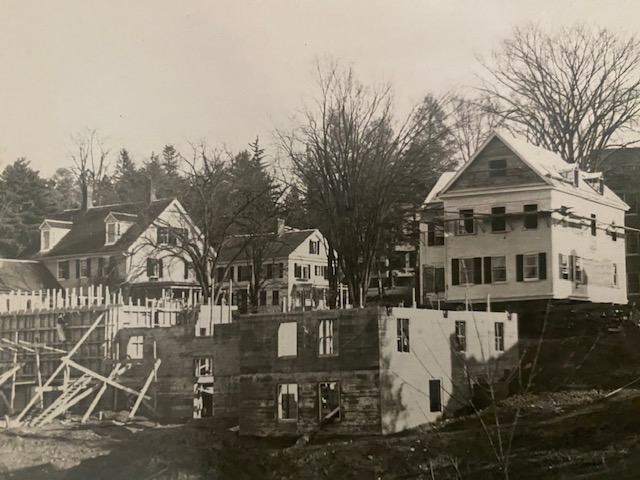
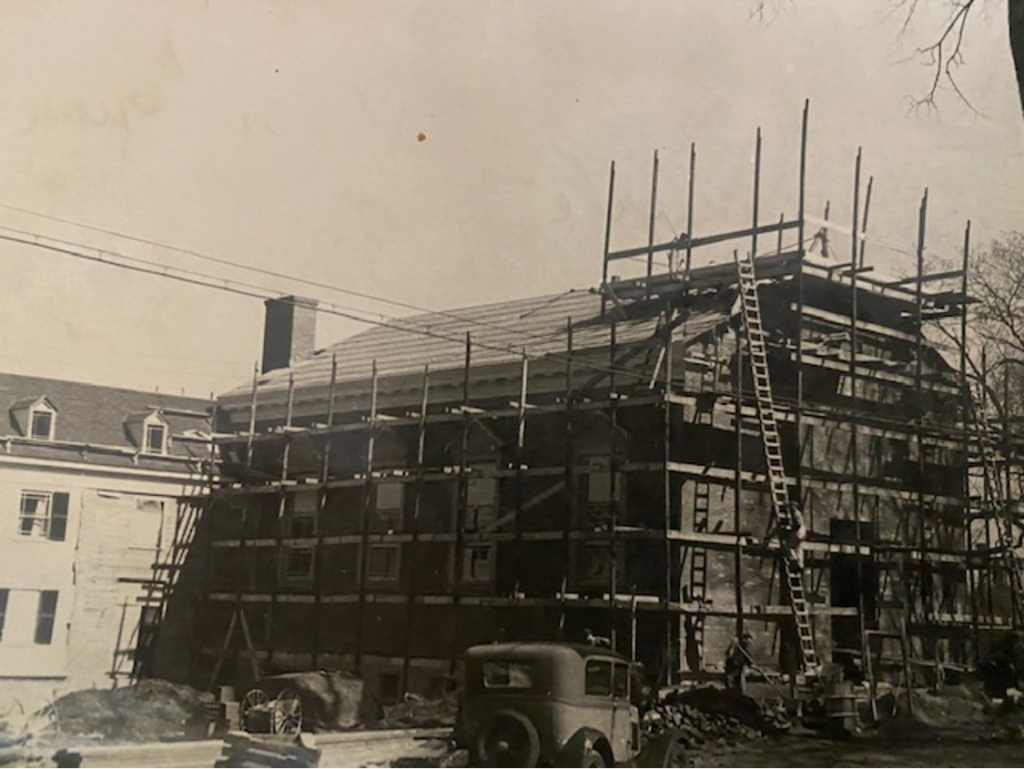
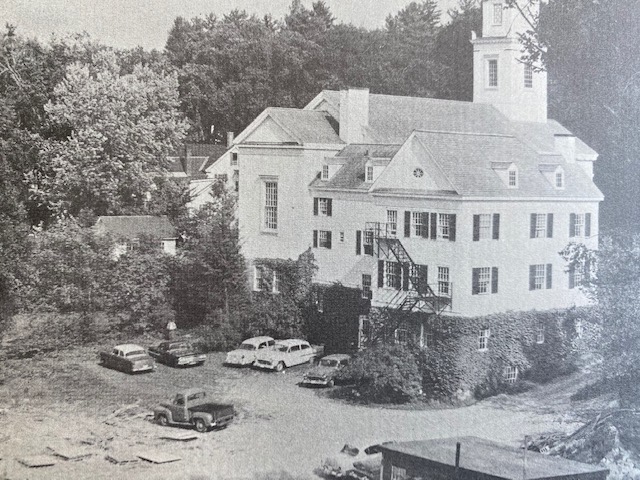
The college wanted to determine the design of the replacement church building to be located at the North end of Dartmouth row. The members rejected this control over the design and hence acquired the land the church now occupies.
Reference: Church Dedicated
The Hamilton Library
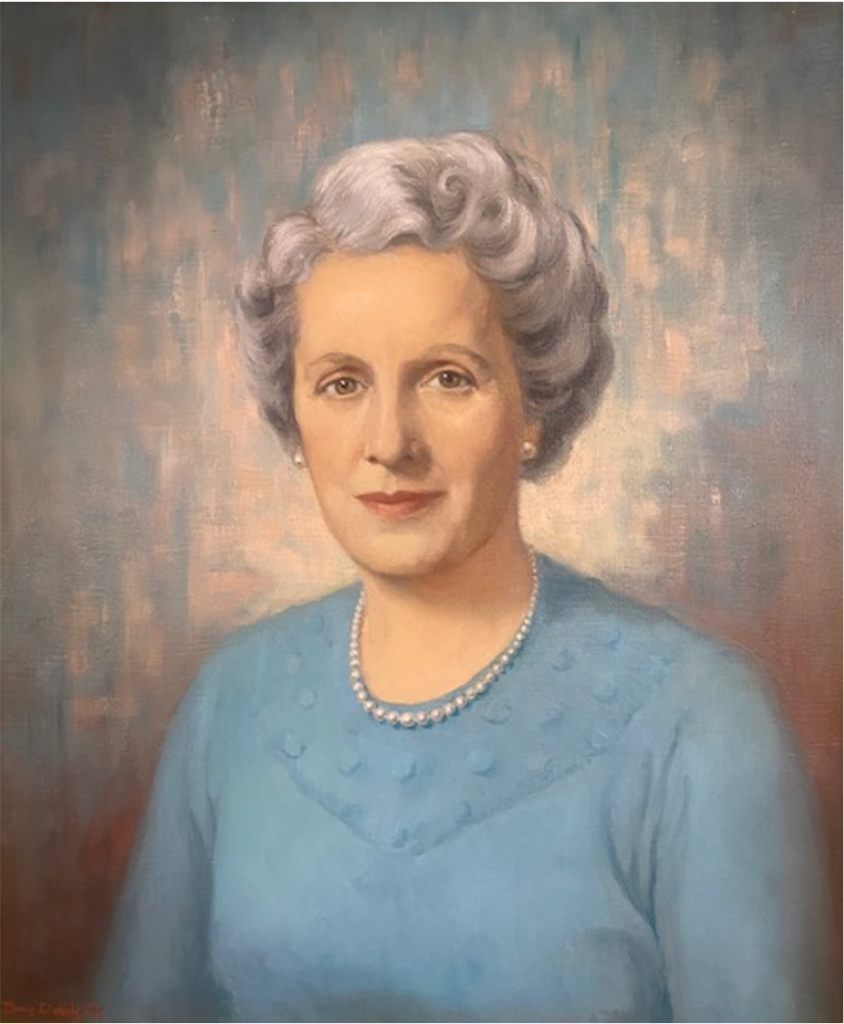
One of CCDC’s “hidden gems” is the Hamilton Library, which has grown steadily over the last 50 years, since the large addition, dedicated in 1963. Settled in its second floor home for decades, the library was bolstered by the addition of the large reference collection from the Bangor Theological School when BTS established a branch office at CCDC 30 years ago. The program of outreach to rural congregations lasted only a few years before
ending, but the rich collection of books remained, and became a valuable resource for several pastors outside of CCDC who used the Hamilton Library as a sermon-writing home base. Jean Keene, who served as the Ray School Librarian for many years, also oversaw the Hamilton Library for decades, partnering in recent years with Susan Shadford, who continues in that capacity.
The Hamilton Library has a large collection of children’s books, which are rotated seasonally to the “branch office” in the Batchelder Lounge. The library corner there also contains several of the regularly-read periodicals, including The Christian Century and Sojourners.
The Hamilton Library was endowed by the Hamilton family in honor of Sabra Martin Hamilton, whose portrait graces the wall there. She was a CCDC member from 1924-1936 when her husband James A. Hamilton was a Professor at the Tuck School and also Superintendent of the Mary Hitchcock Memorial Hospital. That was when
“the Hitch” was next door, just across Maynard Street. A young mother of three, Sabra would later see all of her children marry at CCDC. She died at the age of 59 in 1960 and is buried in Pine Knolls Cemetery. Happily, in recent years her children and grandchildren have visited the Library, thrilled to see how well-appointed, well maintained and useful it has become to the congregation and community. “Truly a lovely lady with a sincere faith and interest in Christian ideals”
Allen Chapel
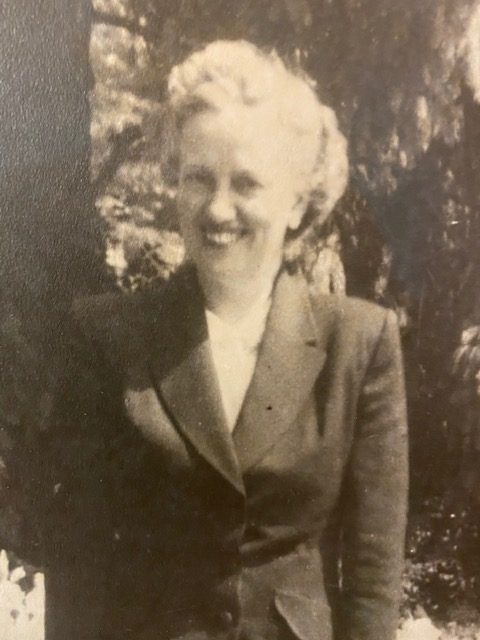
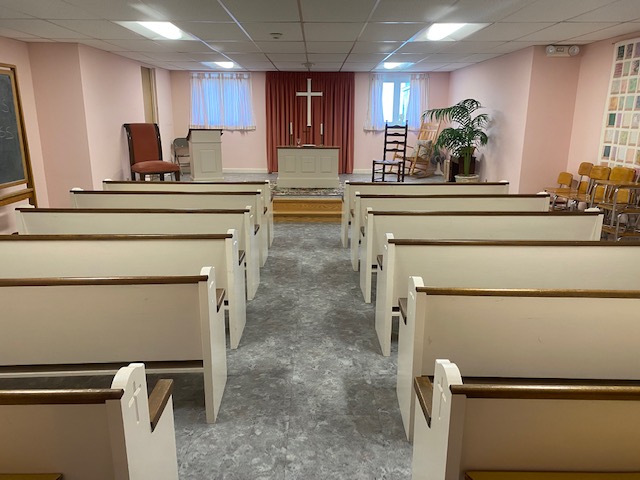
The period from 1935 to 1961 was a period of remarkable growth for the church. In 1954, members dedicated the Kathryn Edie Allen Memorial Children’s Chapel, and it was an unmistakable sign that the church is devoted to the education and mentorship of children. Kathryn’s husband, Chauncey “Chince” Allen, a professor of psychology at Dartmouth, spoke at the dedication of the chapel in 1954 and at its rededication in 1987. A gem of the church, the chapel includes children-sized pews, and is decorated with several art projects, some by the children. By the early 1960s, church school enrollment was nearly doubling. Children had to walk across the street to Dartmouth’s Steele Chemistry Laboratory to attend Sunday School classes, because they couldn’t fit in the church!
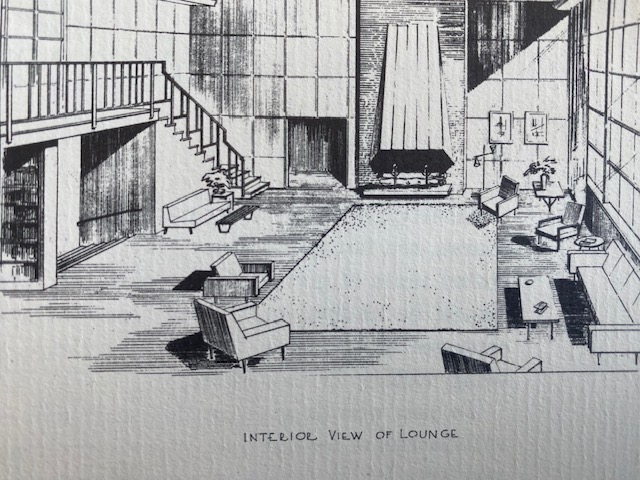
To address their bursting membership, in 1962 the church expanded with a major addition, with three rooms named after outstanding women of the church. They include the airy Batchelder Lounge, named after Grace F. Batchelder, a longtime supporter of the Women’s Fellowship Group; the Rand Room, given in memory of Flora McIver Rand; and Hamilton Library, given in memory of Sabra M. Hamilton. The rooms were dedicated in 1963.
It was during this expansion that the Allen Chapel found a new home downstairs next to the classrooms.
During Chince Allen’s later years, he was known to rise from his pew at appropriate times and share historical stories with the congregation. A lover of CCDC history his memory and that of his wife are honored with the sharing of these stories.
Sanborn Hall
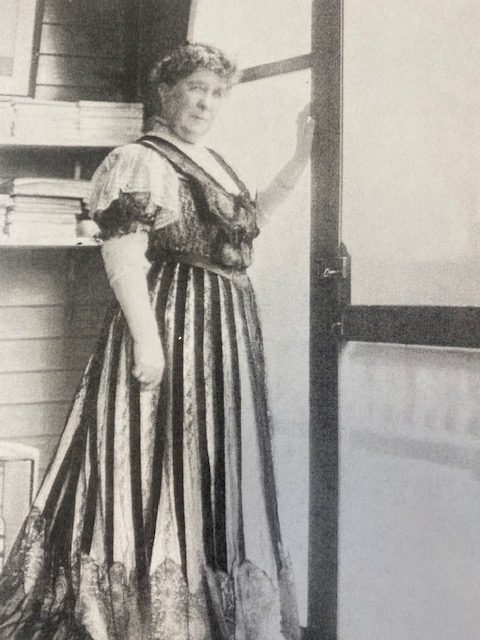
Many notable individuals have grown up in the church and gained fame for their good works, one of the most accomplished and colorful, Kate Sanborn, whose name (and those of her siblings) graces one of the busiest and functional rooms at CCDC, Sanborn Hall, the cavernous space directly below the sanctuary.
Katherine Abbott Sanborn was born in Hanover in 1839. Her father, Edwin David Sanborn, was Professor of Classics at Dartmouth. Her mother, Mary Webster, was a cousin of Daniel Webster. Katherine did not attend school, but was well educated at home. The entire family were longstanding and regular members of the College Church (that’s us), literally a stone’s throw from her family home on the west side of The Green. In her memoirs, she wrote of an intellectually rich childhood in which she was exposed to the politicians, academics and writers who visited her father.
After starting a day school for faculty children, Kate Sanborn continued her teaching career at Mary Institute in St. Louis when her father became President of Washington University for a four-year stint. She later taught at the Packer Institute in Brooklyn, and was a prolific writer of newspaper and magazine articles, also reviewing books for Scribner’s Magazine. In 1880 she was invited to teach English literature at Smith College, leaving Smith in 1883.
A popular lecturer who became known for presenting literary topics in a humorous, entertaining manner, Sanborn traveled extensively throughout the country on speaking tours. In 1885 she wrote The Wit of Women, a collection of anecdotes and commentary that examined how women’s humor was shaped by social attitudes. When she tired of city life, Sanborn moved to the Massachusetts countryside and bought an abandoned farm in 1888. She wrote of her experiences and misadventures as a novice farm manager in two books, Adopting and Abandoned Farm and Selling an Abandoned Farm. She was the first President of New Hampshire’s Daughters, as association of women born in New Hampshire but living in Massachusetts and New Hampshire. She died in 1917 and is buried in the old Dartmouth Cemetery.
It is fitting that Sanborn Hall has always been a center of activity and fellowship at CCDC. It was a hub of post war youth gatherings, with Pastor Chet Fisk calling the weekly square dances, with occasional couples sneaking up onto the back Chase stairs to get acquainted. It was the headquarters of the Goodnight Irene Café, a true coffee house. It has been the scene of countless Easter Breakfasts, plays, talent shows and very recently Dartmouth student gatherings. Very soon, it will open again to the beautiful peals of the rehearsing bell choir, as CCDC slowly, carefully re-opens.
LIFE Magazine
LIFE Magazine
Published February 10, 1947
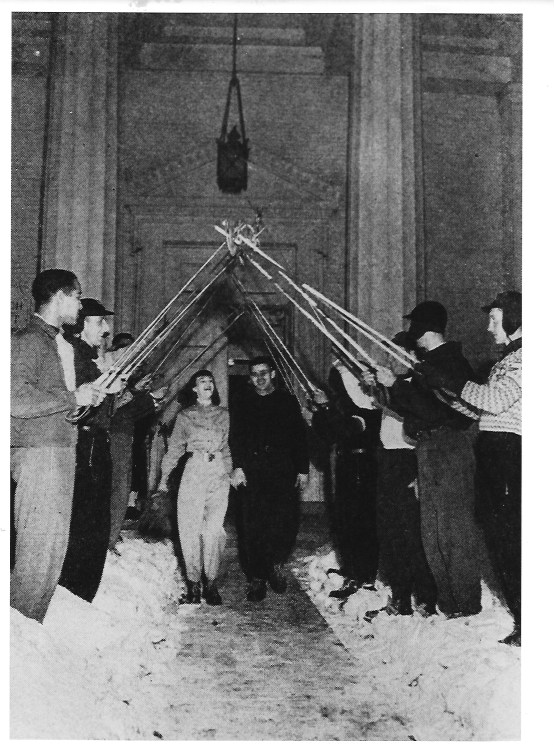
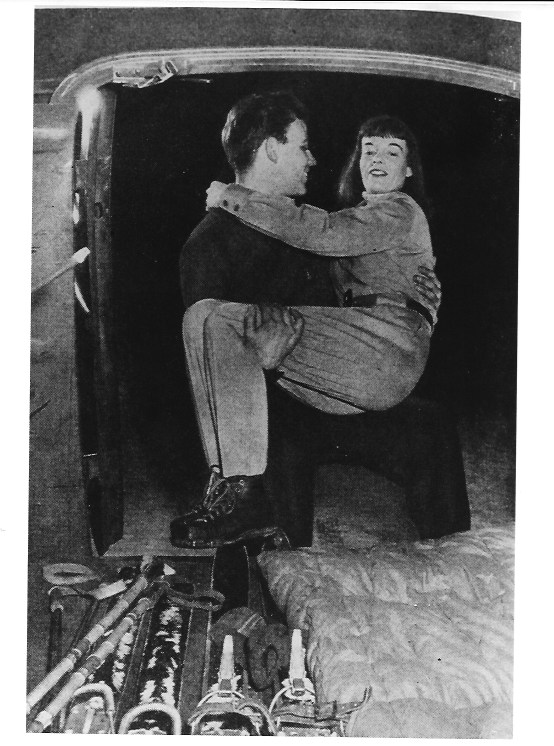
In the February 10, 1947 issue of LIFE Magazine CCDC was featured for hosting the wedding of Hanover native and Dartmouth graduate Robert Meservey, a championship skier and member of the famed 10th Mountain Division, and former Powers Model, Patti Hill. The LIFE photos depict the bride and groom arriving at CCDC on skis (and closer observers will note a residence across the street (not a Dartmouth science building). The photos depicted the candlelit ceremony performed by The Rev. Chester Fisk (CCDC Pastor from 1938-1951), and the organ loft at the back of the church. The newly-married couple exited the very recognizable front of the church under a canopy of ski poles, and left for a ski honeymoon
(note the bamboo ski poles and bear trap bindings).
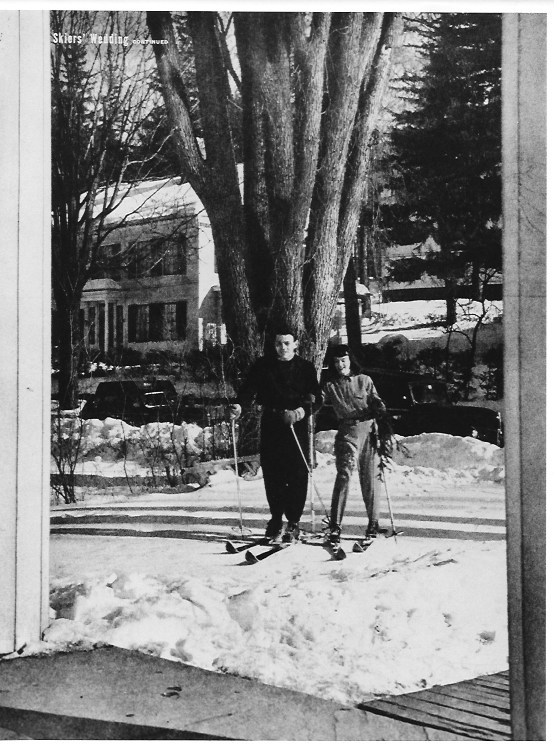
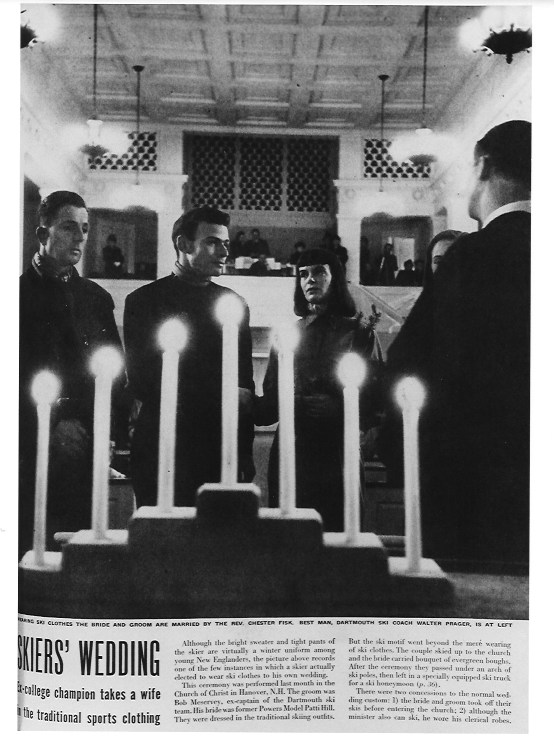
Robert Meservey was born in Hanover in 1921. At Dartmouth, he captained the ski team and won the Eastern Slalom Championship during the winter of 1941-42. Upon graduating, he volunteered for the 10th Mountain Division, like so many of Dartmouth’s skiers of that generation. He served as a corporal instructor in skiing, rock climbing and winter survival. He was awarded the Soldier’s Medal for saving the lives of two soldiers during maneuvers in West Virginia, and was sent to Engineer Officer Candidate School at Ft. Belvoir, VA. From 1944-46 as an Army Engineer officer, second lieutenant, he volunteered for duty in the Pacific Theater, developing night vision equipment, but was assigned to developing heat-sensing equipment at the Engineer Research and Development Laboratory until discharged in 1946.
After the war, Meservey pursued a career as an independent photographer for several years, photographing several famous people, including Robert Frost and John F. Kennedy. He completed a series of photographs of Dartmouth College and did fashion and architectural photography in New York City and Newport, R.I. His most well-known photograph was of Jacqueline Bouvier, later Jacqueline Kennedy, descending the stairs at her coming-out party, which appeared on magazine covers when John. F. Kennedy became President and was used in many later books.
After receiving his PhD from Yale in 1961, Meservey joined the low-temperature physics group at the MIT Lincoln Laboratory in Lexington, Mass. He became a senior research scientist at the Lab, and in 2009, Meservey and two other colleagues received the Oliver E. Buckley Condensed Matter Physics Prize, the highest award given by the American Physical Society. He died in 2013 at the age of 92.
Growth
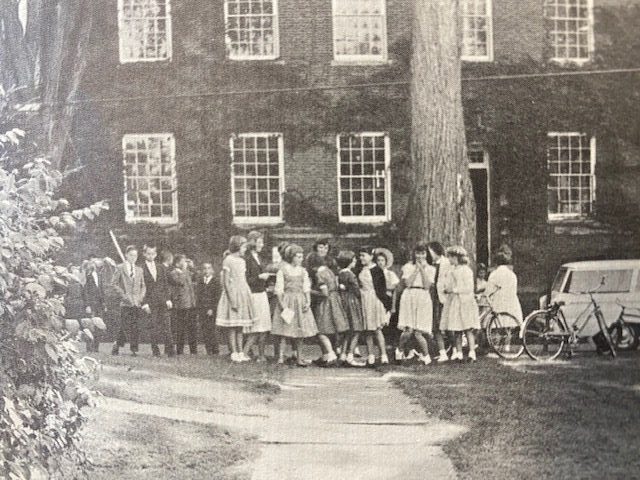
Compare the comfy clothing the kids are wearing to the church school attire shown below, with every boy in a jacket and tie and every girl wearing a dress, ankle socks and patent leather shoes. These church school classes were taught by Jean Keene, Katherine Unger, and Pat Kurtz (later to become Pat Cavanaugh). Pat also taught Junior Church prior to the service in Masland Chapel, with Dr. Lou Matthews playing the electronic organ.
(Door prize to anyone who can identify themselves or anyone else in the photo!).
Church School was crowded in the early 1960s. The country was in the midst of the postwar boom. Yes, these kids were boomers! Hanover was growing quickly. CRREL had just come to town, adding as many as 100 families, and school population was forecast to grow from 931 to 1579 between the years of 1959 to 1970. The Church of Christ at Dartmouth, built in austere times at the height of the Depression, was bursting at the seams. The small classrooms in the parish house were not enough, and as shown in the photo below, some church school classes had to hike across the street for rooms in the Chemistry building.
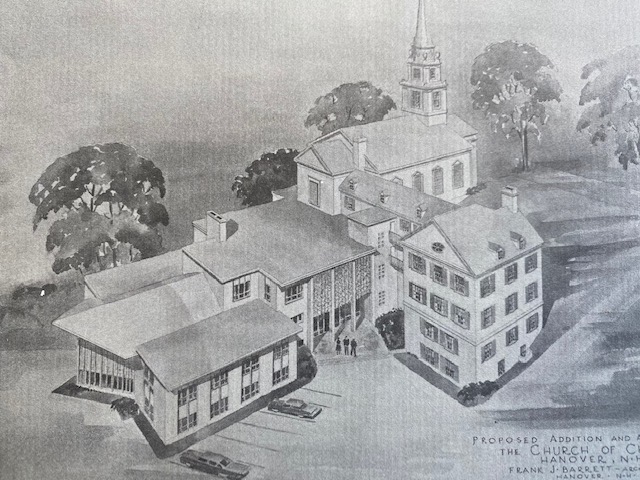
Space for church school and youth programs was at the forefront of the building campaign begun in 1959, and announced in September 1961. The 20-page, lavishly-illustrated capital campaign bulletin stressed the need for more room: “over the past 10 years, growth has been notable, and present birth rates will accelerate it. The Church and Church School have had to resort to double sessions. Lack of space and facilities is recognized by all to be seriously limiting our service. WE MUST HAVE MORE ROOM!
Hanover architect Frank J. Barrett was asked to study the present and future plan needs of the parish and design an addition to the parish house that would meet these needs, At the same time, a task force was formed under the leadership of Thaddeus Seymour to raise the funds for the construction. At the annual meeting in May, 1961, the congregation approved the sum of $200,000 for the building and $35,000 for equipment and furnishings. The proposed addition would add 14,000 square feet to the church’s existing 16,300. Less than a year later, in January 1962, the Building Fund Campaign reported pledges of $204,625, and the Building Committee approved detailed plans for the new building. At a special meeting in April, 1962, the church accepted the bid of Trumbull-Nelson Construction Company to be the contractor.
Sermons
Many of the earlier sermons revealed that many times the sermons given generations ago are relevant as our faith communities grapple with local and national issues.
For the past 70 years there are few if any sermons on file at CCDC. That reflects the trend that holds that the sermon given are the property of the pastors, and it is their responsibility to preserve them. Many nowadays, of course, are on computer hard drives. Printed sermons are a rare commodity. In an effort to complete our archives, Bob Keene has reached out to our pastors since 1950 and requested that they contribute their notable sermons to our records. It is the hope to build a digital, and perhaps even searchable file of these going forward. Stay tuned for updates on this project.
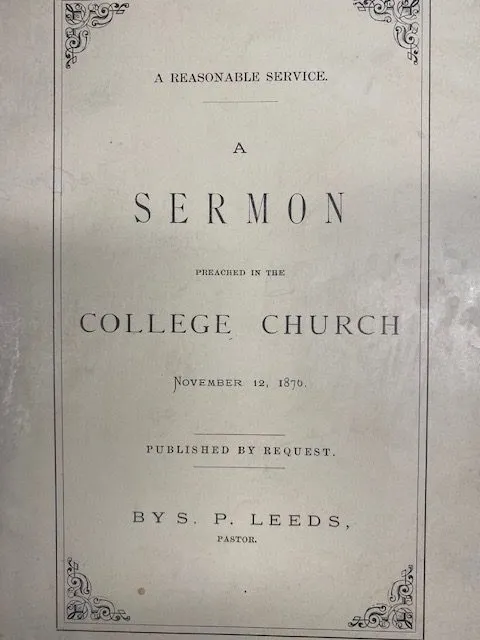
We show the cover from 150 years ago of one of the printed sermons that we do possess, given by the Rev. Samuel P. Leeds, the longest-serving pastor in CCDC history. There is an substantial engraved plaque in the narthex of our church commemorating his 40 years between 1860 and 1900. The plaque was one of the few items salvaged from the great first of 1931. Rev. Leeds showed a strong social conscience in his early years in Hanover, especially during the Civil War.
Leeds was an effective leader for those who were fortunate to experience his humor, intelligence and kindness in private conversation. The college helped the situation somewhat by cutting compulsory Sunday Church attendance from two services to one in early years in Hanover, especially during the Civil War. Leeds did found the Young People’s Society of Christian Endeavor to give the youth more of a role in the Church and he presided over five revivals, each bringing in twenty to thirty new members.
See our Sermons page for more information.
25 Years of Habitat
25 years ago, The Rev. Carla Bailey organized the first service trip to the Mississippi Delta to work with a local chapter of Habitat for Humanity. Inspired by work of her mother Olive, who had brought groups from Minnesota, Carla began a tradition that has continued ever since, only interrupted due to the pandemic. The timing during February school vacation has always allowed for the inclusion of young people, and among the more than 100 volunteers from CCDC and the community who have come over the years, more than two dozen have been high school students.
The first years were centered around work in Farrell-Sherard, an affiliate on the site of a former plantation on the outskirts of Clarksdale. From the very beginning, the work was characterized by the partnership between the local members of the Habitat chapters, the families working on the homes they would be living in, and the volunteers from all over the country. The relational aspect of the work was critical for all of the stakeholders, and over the years many lasting friendships were build. There are many CCDC members who have their own stories, for instance, about their interactions with the legendary teacher Ida White, and with current Jonestown Executive Carl Fuller and his wife Lorna.
After several years of work with the Farrell-Sherard affiliate, CCDC crews began working in the small town of Jonestown, on the eastern outskirts of Clarksdale. A generous gift of land made it possible to begin work on a new cul de sac that now boasts more than a dozen new homes on a now-paved road, rising above the notorious Mississippi mud. A former convent building in Clarksdale had provided comfortable housing for volunteers in the last decade, a noted improvement over the cramped former headquarters in Jonestown.
There are hundreds of stories that our CCDC volunteers have shared: the friendships with homeowners, the potluck suppers, worship at the AME church in Cleveland, visits to local schools with book donations, evenings out at the Ground Zero Blues Club, as well as local juke joints, trips to Memphis to visit the Civil Rights Museum, the joy and emotion of sharing in a dedication ceremony. Feel free to share yours, as we recall a chapter in CCDC that is still being written!
The Wheelock Residency and DHMC Chaplaincy
One of the duties that David Yohn assumed when he arrived at CCDC was coordinating the volunteer clergy chaplains at Mary Hitchcock Hospital, across the street from the church, taking over from the Rev. Bob Johnson from Woodstock. In essence, he became the Hospital Chaplain, since he was on the scene and so many of the physicians were members of CCDC. Although the need was clear for a fulltime chaplain at the hospital, the administration was not ready to consider this. In consultation with President George Peck of the Andover Newton Theological School, and with the help of a group of interested CCDC members, Rev. Yohn created the idea of a residency program for recent seminary graduates. They created the Wheelock Residency Program, which was approved by the congregation on October 29, 1967. A sponsorship was provided for a two-year residency for a recent seminary graduate to work under the guidance of the ministers and lay leaders to minister to hospital patients and their families, the Dartmouth students, and assist with the general life of the church. Money was raised to build and furnish an apartment in the parish house (the one which remains in use to this day).
In May, 1968 the church welcomed recent ANTS graduate Harvey Pinyoun and his wife to move into the apartment. Harvey was the first Wheelock Resident, which David Yohn says was “one of the smartest things we ever did at CCDC”. The only drawback of the new apartment was that it was situated over the well used Youth Lounge. Oops! Harvey’s service was distinguished. He became the full-time Chaplain to the hospital. Bill Nelson followed him as the next Wheelock Resident.
The chaplaincy program has continued to grow at Dartmouth-Hitchcock Medical Center, and now has five full-time chaplains, as well as several part-time multi-faith chaplains. In addition, the DHMC Chaplaincy program has become an educational center, teaching CPE (Clinical Pastoral Education) to seminary students and potential pastors. CCDC’s John Torrey has just completed a comprehensive CPE program there, and is now doing a full-time chaplaincy residency at a hospital in New Haven. The circle is complete.
250th Anniversary
On January 31, 2021, we held our 250th Anniversary Service. See our videos celebrating this momentous occasion.
The Maclay Architects
Throughout 2022, Maclay Architects did an assessment and master plan for CCDC. The assessment was to review our buildings architecture, building code and accessibility, structure, mechanical and energy conditions. The study concluded in April of 2023 and the final Maclay Executive Summary can be found here.
The Christmas Market
Since 1987, Christmas Market with a Difference offered our congregation and the surrounding community the opportunity to purchase handcrafted goods from nonprofit fair trade and charitable organizations around the world.
We like to say that the “difference” between our Market and other holiday markets was that ours is not a fundraiser for our church; 100% of the proceeds are returned directly to organizations helping people in need worldwide— from here in the Upper Valley to as far away as Nepal and Zimbabwe.
One year, the Market brought in $79,044 for the twenty participating organizations, and an additional $1,785 in Café sales. Over the years, Christmas Market with a Difference raised a total of over $1.5 million for the participating nonprofit organizations.
The history of CCDC’s Christmas Market with a Difference goes back to 1987, when it grew out of the work of the Outreach Board of our Church. The idea, as proposed by church member Jean Sibley, was to provide a market for sweaters made by three knitting cooperatives— two in economically depressed areas in Korea and Nepal, and one right here in New Hampshire. The Market was to be a service to these groups and not a fundraiser for the church.
It was decided to include both Heifer International and the nonprofit, fair-trade retailer SERRV in the first Christmas Market. With only three months to prepare, and with the help of many willing hands under the leadership of Jean Sibley and Associate Pastor Margot Pickett, the 1987 Market was a rousing success, raising almost $7,000 for the knitters, $2800 for SERRV, and $750 for Heifer International.
In 1988, under the leadership of Susan Barton, the Market was expanded to include Koinonia Partners, Cadagren Co-op, Mabel Roberts toys, and a book sale. The next year, Pueblo to People and Upper Valley Hospice were added as partner organizations.
Each year the roster of partnering non-profit organizations grew, and with each new chair, innovations were implemented and changes made to improve the operation of the Market.
In 2001, church volunteers began to provide donated soups and baked goods to sell to shoppers at a new Christmas Market Café. From that point onward, proceeds from Café sales have been used to fund the operating and advertising expenses of the Market.
Over the years, more than forty organizations have participated in Christmas Market with a Difference. Many of these groups represent women’s cooperatives that use their earnings to support themselves and their children. Other organizations sponsor schools, orphanages, and group homes for the mentally ill or survivors of abuse. Recently, market organizers have strived to include organizations promoting environmental conservation and sustainability, as well as groups serving immigrants and refugees at home and abroad. One of the most wonderful aspects of this long-time church tradition is that our entire congregation pulls together to make it happen. Volunteers help prepare soups and baked goods for the Market Café, move furniture to make room for the sale, put up signs, set up displays, greet patrons, assist shoppers on the salesfloor, check out customers, and then clean everything up when the three days of sales are over. Each year, over 150 volunteers cover over 300 different volunteer shifts to make the Market a success… and we had great fun doing it!
Our final Christmas Market was held November 3rd and 4th of 2023. Participating organizations that year were Artists for Soup (Nicaragua), Association for Craft Producers (Nepal), Church World Service, Circus Zambia, Cocoa Farming Future Initiative (Grenada), Friends of Oaxacan Art (Mexico), Partners in Global Change (Tysea Orphanage, Haiti), Koinonia Farm (Georgia, USA), Mil Milagros (Guatemala), Q’ewar Project (Peru), SERRV, Shimena Weaving Friendships (Ethiopia), Tuko Pamoja (Kenya), UNICEF, and Zienzele Foundation (Zimbabwe).
Christmas Market with a Difference Chairpersons over the years:
- 1987 Jean Sibley
- 1988-1991 Susan Barton
- 1992-1993 Marie Elise Young
- 1994-1996 Sally Foss
- 1997-1999 Joan Schaafsma
- 2000-2001 Joan Schaafsma & Jane Meador
- 2002 Jane Meador
- 2003 Jane Meador & Nancy Emslie
- 2004-2005 Nancy Emslie
- 2006-2008 Corinne Fortune
- 2009-2011 Sae-Im Smith
- 2012- 2014 Amy Tietjen Smith
- 2015-2016 Sarah Nordstrom
- 2017 Sarah Nordstrom & Emily Dentzer
- 2018 Emily Dentzer
- 2019 Emily Dentzer & Gail McPeek
- 2020 Emily Dentzer & Gail McPeek
- 2021 Emily Dentzer & Gail McPeek
- 2022 Emily Dentzer & Gail McPeek
- 2023 Emily Dentzer & Gail McPeek